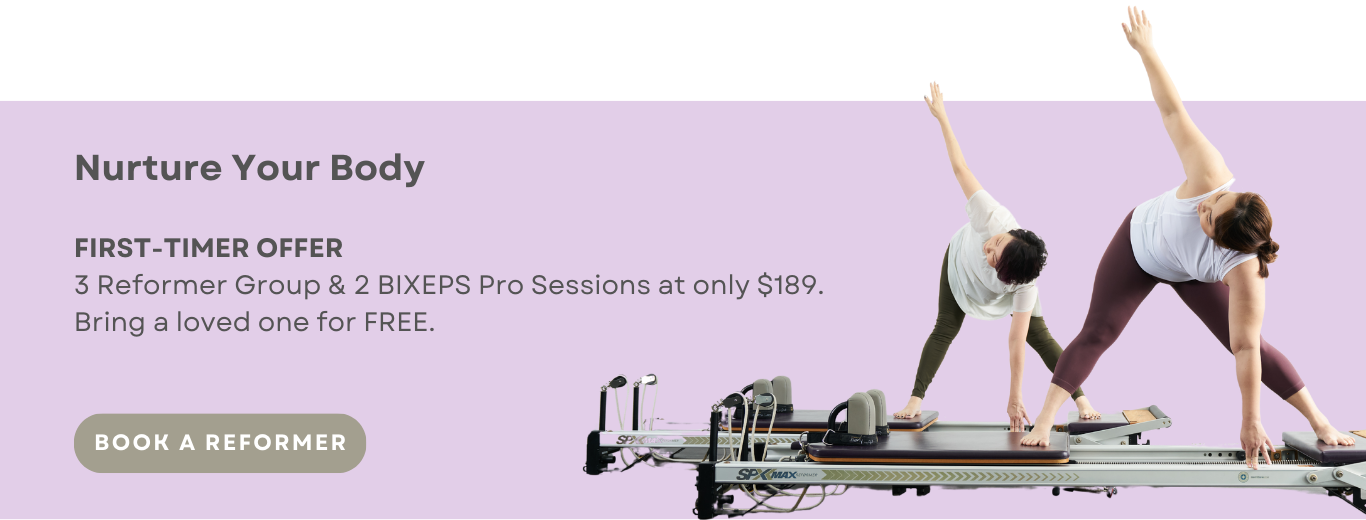

Skip Half-Baked Instructors – Do Reformer Pilates Right with Our Experts.
✔ Experience real-time posture adjustments and personalized guidance
✔ Small class size of 10 pax with hands-on corrections
✔ Proven Routines Trusted by 16,000 Members Since 2010
Grab First-timer
offer now!
Get started today with 5-minute Pilates Home Workout that has already helped over 16,000 people.
FAQ PLACEHOLDER
The Bump is Exciting, But Exercise Feels Confusing
You're pregnant, and your body is changing faster than you imagined. Your center of gravity shifts. Your back aches. You're exhausted, yet you know staying active matters. But here's the problem: every article tells you to exercise, but nobody tells you how to do it safely when you're carrying another life.
Should you just rest? Follow free YouTube videos? What if you accidentally hurt your baby?
Here's what most expecting mums in Singapore don't realize: the right exercises don't just help during pregnancy—they transform how you feel after birth. When your core stays strong through pregnancy, labor becomes more efficient. When your pelvic floor is toned, recovery happens faster. When your posture is supported, you avoid the chronic back pain that affects so many new mums. The difference? Mums who move intentionally during pregnancy report less pain, faster healing, and more energy to enjoy those precious early weeks with baby
Prenatal Pilates is the doctor-recommended, low-impact solution that builds strength, manages discomfort, prepares your body for birth, and promotes faster recovery. This isn't about fitness goals or aesthetics. It's about supporting your body through one of its biggest physical transformations—so you can feel strong, comfortable, and confident throughout pregnancy and beyond.
This guide covers everything a beginner needs to know: when it's safe to start prenatal Pilates in Singapore, what happens in your first class, how to choose a qualified instructor or studio, and exactly what modifications you need for each trimester.
Let's be honest: pregnancy makes you feel like a stranger in your own body. Your balance is off. Everything aches—whether you move or stay still. You feel like your body isn't cooperating anymore. And you're genuinely scared of doing the wrong thing and hurting your baby. This is exactly why prenatal Pilates isn't just "nice to have"—it's how you take back control and prepare your body for both birth and the months that follow.
As your bump grows and your breasts become heavier, you become "front-heavy." Your center of gravity shifts forward, throwing off your balance and making you more prone to falls—especially on Singapore's uneven pavements, steps, or slippery bathroom tiles.
Prenatal Pilates targets your deep stabilizer muscles (the ones you can't see but absolutely need). These muscles improve your proprioception—your body's awareness of where it is in space. As the Reformer carriage glides back and forth, your body instinctively learns to adjust to your changing weight distribution, significantly reducing your fall risk. This is one of the most unique benefits of Reformer training: you're strengthening your core stability without even realizing it.
Think of it as training wheels for your pregnancy body. You're teaching your muscles to adapt as your weight changes, so you stay steady and confident on your feet.
Here's what nobody tells you: by your third trimester, nearly all women experience some degree of abdominal separation called Diastasis Recti (DR). The question isn't whether your abs will separate—it's how much they separate and whether they'll close back properly after birth.
Traditional exercises make this worse. Crunches, planks, and even certain yoga poses create excessive intra-abdominal pressure that pushes your abdominal wall outward (called "doming"). You're literally forcing your abs apart.
Prenatal Pilates focuses on your Transverse Abdominis—the deep corset-like muscle that wraps around your torso. Combined with proper breathing techniques, you learn to engage your core without creating pressure. This protects your abdominal wall from excessive separation during pregnancy and, critically, trains your abs to close back together normally after birth—minimizing or eliminating the gap.
The goal isn't preventing separation during pregnancy (that's natural). The goal is ensuring your core can heal properly and function fully after delivery—so you're not dealing with a persistent gap, core weakness, or chronic back pain months or years later.
Imagine carrying a 10-15kg weight on the front of your body, 24 hours a day, for months. Your lower back curves excessively (lordosis). Your shoulders round forward from breast weight. Your hip flexors tighten. Your glutes weaken.
This isn't just uncomfortable—it's a recipe for chronic pain that extends long after delivery.
Prenatal Pilates strengthens your posterior chain: upper back, glutes, and hamstrings. These muscles counteract the forward weight shift, preventing the muscle imbalances that cause back pain, sciatica, and pelvic tension. Every exercise teaches you how to maintain neutral alignment even as your bump grows.
You're essentially building a stronger "frame" to carry your pregnancy weight. The earlier you start, the less pain you'll experience in your third trimester.
Pregnancy increases your risk of Gestational Diabetes Mellitus (GDM), which affects approximately 20% of pregnant women in Singapore. GDM can lead to complications for both you and your baby, including a bigger baby at birth (macrosomia), which makes labor more difficult and increases the risk of emergency C-sections.
Consistent resistance training—like Pilates—helps regulate blood sugar levels, reducing your GDM risk. But the benefits go beyond diabetes prevention.
The controlled, full-body movements in Pilates boost circulation throughout your lower body. This helps combat the leg cramps and swelling (edema) that plague so many pregnant women, especially in Singapore's humid climate. Better circulation means less fluid retention, less discomfort, and healthier legs.
Here's the truth about pelvic floor training: most women only know how to "squeeze" (Kegels), but they never learn how to release.
During labor, your pelvic floor must relax and lengthen to allow your baby to pass through the birth canal. If your muscles are tight and can't release properly, you're working against your own body during delivery. This leads to longer labor, increased tearing risk, and more difficult recovery.
Prenatal Pilates teaches both activation and release. You learn to engage your pelvic floor for everyday support (preventing incontinence and prolapse), but equally important, you learn to consciously relax these muscles—a skill that becomes critical during pushing.
Think of it as training for the most important athletic event of your life. Labor is a marathon, and your pelvic floor is your most important muscle group.
Let's be real: pregnancy sleep is terrible. Your hips ache. You can't get comfortable. Cramps wake you up in the middle of the night. Your mind races with anxiety about labor, parenting, and whether you're doing everything right.
Prenatal Pilates incorporates rhythmic, mindful breathing with controlled movements. This combination activates your parasympathetic nervous system—your body's "rest and digest" mode. During the 55-minute class, you're not only toning essential muscles and stretching tight ones—you're training your nervous system to downregulate, which improves sleep quality even when sleep quantity decreases.
The mental focus required during class also provides a break from pregnancy anxiety. For 55 minutes, you're not thinking about birth plans or nursery colors. You're present in your body, moving with intention. This mindfulness carries over into daily life, helping you manage stress and stay emotionally grounded.
Nobody warns you about "motherhood pain"—the chronic neck, shoulder, and lower back pain that develops from carrying a newborn, bending over the crib, and nursing in awkward positions for hours every day.
A newborn doesn't weigh much, but you'll carry that weight for 8-12 hours daily. You'll bend, lift, twist, and hold positions that wreck your body if you're not prepared.
Prenatal Pilates strengthens the exact muscles you'll use for baby care: your upper back (for holding baby), your glutes (for getting up and down from the floor), and your core (for lifting the car seat). You're training for the physical demands of motherhood before they begin, preventing the chronic strain that leaves so many new mums in pain for years.
This is also why we're Singapore's first and only studio offering Couple Prenatal Pilates—because both parents need to be physically strong to care for baby together. When your partner trains alongside you, they learn proper lifting techniques, understand the physical demands you're both about to face, and can support you effectively during recovery. Parenting is a partnership, and physical preparation should be too.
Here's the harsh reality: imagine not using your abdominal muscles for nine months and expecting them to support you after birth. That's exactly what happens if you don't exercise during pregnancy.
Your muscles atrophy. Your cardiovascular fitness declines. Your bone density decreases. When you finally return to exercise postpartum, you're starting from zero—or worse, from a weakened, injured state.
Maintaining muscle strength during pregnancy means faster, safer postnatal recovery. Fit mothers heal more quickly from delivery (whether vaginal or C-section), experience fewer complications, and return to normal activities sooner. Your overall maternal health improves, which directly benefits your ability to care for your newborn.
Just last week, I met a new mum still suffering from tailbone pain every time she sits or stands—five months after giving birth. This is preventable with proper prenatal training.
You're convinced prenatal Pilates matters. But now the practical questions surface: When exactly should you begin? Who can you trust? And honestly, can't you just follow YouTube videos at home for free?
The Second Trimester is the Sweet Spot. Between weeks 13-27, most women feel their best: morning sickness has passed, energy returns, and your bump isn't too heavy yet. This is the ideal time to build strength before your third trimester, when every movement feels harder.
But what if you're already in your third trimester? It's not too late. In fact, exercising later in pregnancy is generally safer for baby—you're just working with more weight and fatigue. Proper modifications allow you to start even in your final weeks, provided you have doctor's clearance and a certified prenatal pilates instructor.
The real danger is waiting until after birth to start exercising. By then, your body has adapted to nine months of weakness, and recovery becomes exponentially harder.
This isn't optional, but it's also not complicated. Every pregnancy is unique, and your obstetrician knows your complete medical history. A quick clearance confirms that Pilates is safe for your specific situation—or whether you need any modifications.
Most healthy pregnancies are cleared without issue. However, certain conditions (like high-risk pregnancies or specific complications) may require modified exercise or temporary restrictions. Your doctor will let you know if this applies to you.
Reputable Pilates studios in Singapore will ask for this clearance before your first class. This isn't bureaucracy—it's a sign that the studio takes your safety seriously and follows clinical guidelines.
Let's address the elephant in the room: "Can't I just follow prenatal yoga videos at home for free?"
Here's why that's not recommended.
A video cannot see you. It can't spot the subtle abdominal doming that signals Diastasis Recti. It can't check whether you're in a position that compresses your Vena Cava (the major vein supplying blood and oxygen to your baby). Here's the scary part: if your Vena Cava is compressed, your baby isn't getting enough oxygen—but you won't feel anything wrong. By the time you notice something's off, it may already be affecting your baby. A video cannot modify exercises for your specific trimester, muscle imbalances, body type, or pre-existing conditions. And critically, you can't verify if the instructor is certified—there's no accountability if something goes wrong. If you're training at a registered studio in Singapore, you have recourse through relevant authorities if needed.
Most critically, a video can't account for Relaxin—the pregnancy hormone that loosens your ligaments to prepare for birth. Relaxin makes you more flexible, but also more prone to joint instability and injury. You might feel like you can stretch deeper or move further, but you're actually overstretching and risking long-term joint damage. This is also why we discourage prenatal yoga, especially in the third trimester when Relaxin levels are highest.
A certified prenatal Pilates instructor identifies these risks in real-time and modifies your workout accordingly. They know which positions to avoid, how to cue proper breathing to protect your core based on your strengths and weaknesses by observing how you move in real-time, and how to progress or regress exercises based on your energy level that day.
This is why prenatal certification from a reputable Pilates education program matters—such as Merrithew STOTT or Polestar training. A general Pilates instructor—even an excellent one—will not have been trained in pregnancy-specific modifications. You need someone who specializes in prenatal biomechanics and, ideally, has worked with pregnant women for several years.
Not all prenatal Pilates classes in Singapore are created equal. Before you commit, ask these seven questions to separate true prenatal specialists from studios just offering "pregnancy-friendly" classes:
1. Is your instructor Pre/Postnatal Certified from a reputable Pilates education program? How many years have they been teaching prenatal Pilates specifically?
Generic Pilates certification is NOT the same as prenatal specialization. Look for certifications from Merrithew STOTT, Polestar, or equivalent programs that cover Diastasis Recti assessment, Vena Cava precautions, trimester-specific modifications for Relaxin, and pelvic floor training taught by trainers specialising in prenatal health.
Experience matters critically: A newly certified prenatal instructor may miss subtle postural compensations, struggle to articulate real-time corrections, or not recognize early signs of abdominal doming. Ask: "How many pregnant clients have you worked with?" You want someone with at least 2-3 years of prenatal-specific experience.
2. Do you conduct Diastasis Recti assessments before and during pregnancy, and do you know how to modify if DR is present?
Many studios skip this entirely. A qualified instructor should check your abdominal wall integrity and adjust exercises accordingly. Ask: "What exercises do you avoid if DR is detected?" If they can't answer specifically, that's a red flag.
3. Do you offer dedicated prenatal classes, or do you mix pregnant women into regular Pilates classes with "modifications"?
This is critical. Studios that accept pregnant women into regular classes and say "don't worry, we'll give you modifications" fundamentally misunderstand prenatal exercise.
Prenatal Pilates requires a completely different set of exercises—not just modified versions of regular Pilates. The goals are different (stability over strength, pelvic floor preparation over core compression, preventing DR over achieving flat abs). The positions are different (avoiding supine, managing Relaxin, accommodating a shifting center of gravity). The pace is different (slower, breath-focused, mindful).
A well-trained prenatal instructor designs workouts specifically for pregnant bodies, not regular workouts with adjustments. Mixing pregnant women into general classes means:
If a studio says "you can join any class, we'll modify," avoid them. You need dedicated prenatal classes with prenatal-certified instructors.
4. What quality of Reformer equipment do you use, and what props are available?
Not all Reformers are created equal. Premium, well-maintained Reformers won't break mid-movement—a critical safety factor when you're pregnant and off-balance.
But equally important: Does the studio have a full range of props? Foam rollers for spinal alignment, stability cushions for balance training, light weights for upper body strengthening, Pilates rings for inner thigh work—these props allow the instructor to add variations, provide additional support, and keep classes engaging as your body changes week by week.
Limited props mean limited ability to truly customize your workout for your specific needs that day.
5. What is your maximum class size, and is the routine customized daily or pre-set?
Small class sizes (maximum 6-10 participants) are essential, but here's what separates exceptional instructors: Do they customize the routine on the spot based on how you feel that day?
The best prenatal instructors check in before class—energy level, aches, sleep quality, trimester concerns—and design the entire workout in real-time. This requires extensive experience and confidence.
Ask: "If I'm exhausted today, how would the class change?" If they say "we have modifications," that's still a fixed routine. You want: "I'd completely adjust the focus to gentle stretching and breathing."
6. How do you handle supine (lying on back) exercises after 20 weeks? What's your policy on Vena Cava compression?
Lying flat can compress the Vena Cava and reduce oxygen to your baby. You won't feel it, but your baby will.
A knowledgeable instructor should immediately explain: “We do not include ANY supine exercises in our prenatal classes. All movements use incline positions, side-lying alternatives, or seated variations.”
If they look confused about Vena Cava or say 'just tell us if you feel dizzy,' they don't understand the physiology. By the time you feel dizzy, your baby has already been affected.
7. Do you offer Couple Prenatal Pilates classes where partners can train together?
This is a game-changer that most studios don't offer. Some dads feel anxious about their pregnant wives exercising alone, worrying about safety or whether they're overdoing it. Couple Prenatal Pilates allows your partner to train alongside you—not just watching from the sidelines, but actively strengthening their own body for the physical demands of parenthood.
Your partner learns:
Parenting is a partnership. Physical preparation should be too. When both parents train together, you're building a stronger foundation for the exhausting early months ahead.
8. Can I do a trial session before committing to a package?
Reputable studios let you try a single class first. This lets you assess:
If a studio pressures you to buy a package immediately without letting you experience the class first, walk away.
You've got doctor's clearance. You've found a certified instructor at a reputable Pilates studio. Now for the practical details: how to book, what to bring, and what actually happens during your first class.
Prenatal Pilates requires an adaptation period. Your first class involves learning new equipment, unfamiliar movement patterns, and how to engage deep stabilizer muscles you may not have consciously activated before. Most beginners find their second and third sessions feel significantly different as their body begins to understand the Reformer mechanics and breathing coordination.
Several factors can affect your first-class experience—energy levels that day, mental adjustment to new movements, or initial muscle soreness from activating dormant muscles. These temporary challenges don't indicate whether prenatal Pilates is right for you; they simply reflect your body's natural adaptation process to new physical activity.
The immediate vs. delayed benefit phenomenon:
Research and anecdotal evidence consistently show that how you feel during your first prenatal Pilates class differs dramatically from how you feel afterward. Many expecting mothers report that while they felt challenged during their inaugural session, they experienced significant improvements that same evening: deeper sleep quality, reduced back and pelvic pain, diminished leg cramps, and an overall sense of physical lightness and energy.
This contrast between short-term effort and sustained benefits explains why expectant mothers who commit to at least one month of consistent practice (at least 1 session weekly) often continue the prenatal pilates classes through their entire pregnancy. The cumulative effects of regular practice become integral to managing pregnancy discomfort.
Prenatal Pilates studios typically offer online booking or WhatsApp reservation. You'll need to:
Payment options: Studios generally accept digital payments (PayNow, bank transfer) or credit cards.
Wear to class:
Bring with you:
Before class:
That's it. No special equipment. No complicated prep. Just show up.
Check-in: Arrive 10 minutes early for your first class. The instructor will:
Pre-class consultation:
Your instructor checks in with the class:
This conversation shapes your entire workout for the day.
The warm-up (10 minutes): Gentle movements to prepare your body. Focus on breathing, spinal mobility, and waking up your core muscles safely.
Main workout (35-40 minutes): Here's what makes prenatal Pilates different from regular exercise classes: there is no fixed routine. However, you should expect a comprehensive full-body workout focusing on spinal mobility, postural muscles (especially upper back and glutes), core stability, and pelvic floor training.
Based on your pre-class check-in, the instructor customizes the entire routine on the spot. If you're feeling fatigued, the pace may be adjusted to gradually build energy as the session progresses. If you're experiencing lower back pain or pelvic tension, exercises will target glute activation, spinal mobility, and core engagement to relieve pressure. All exercises are designed to avoid Vena Cava compression and abdominal doming, ensuring safety for both you and your baby.
A note on instructor experience: This level of real-time customization requires extensive prenatal training and experience. If you notice workouts repeating week after week without much variation, this may indicate limited expertise. Experienced prenatal instructors continuously adapt programming because every pregnant body changes week to week—sometimes even day to day.
The pace: More controlled and deliberate than regular Pilates, with less emphasis on dynamic stability work. You focus on activating the correct muscles in coordination with your breath—inhaling and exhaling intentionally with each movement.
Modifications: Every exercise includes multiple options. Your instructor demonstrates the foundational movement, then shows adaptations for different body types, trimesters, energy levels, and comfort. You're never pushed beyond your limits—the goal is sustainable strength building, not exhaustion.
Cool-down (5-10 minutes): Gentle stretching, pelvic floor relaxation techniques, and breathing practice to help your nervous system downregulate.
Important: Listen to Your Body
It's completely okay to:
Your instructor is watching for:
You're never alone in managing your safety—your instructor is actively monitoring throughout.
Cool down: Take a few minutes to hydrate and let your heart rate settle before leaving.
Questions: Your instructor may give you simple homework (gentle stretches or breathing exercises to practice at home) and answer any questions about exercise during pregnancy.
Booking your next class: Remember to book your class weekly to reap the best benefits.
You've learned why prenatal Pilates is essential, not optional. You understand the risks of doing nothing—or worse, following generic YouTube routines without professional guidance. Moving intentionally during pregnancy sets the foundation for everything that comes after.
Here's the reality: Can you imagine not using your abdominal muscles for nine months and expecting them to support you after birth? Your body doesn't pause during pregnancy. It's either getting stronger or getting weaker. There's no middle ground.
When you keep your core engaged and functional throughout nine months, labor becomes more efficient. When your pelvic floor is trained, recovery happens faster. When your posture is supported, you move through pregnancy feeling strong rather than struggling.
A fit body means:
This is about setting yourself up for the best possible experience—during pregnancy, through birth, and into those precious early weeks with your baby.
Ready to start? Join Singapore's first and only Couple Prenatal Pilates class and experience the difference that certified, personalized instruction makes—for both you and your partner.
Your body is doing the hardest work it will ever do. Give it the support it deserves.
1. I have Gestational Diabetes (GDM) or Pelvic Girdle Pain (PGP). Can I still join prenatal Pilates?
Yes, with doctor's clearance. Prenatal Pilates can actually help manage both conditions. For GDM, consistent resistance training helps regulate blood sugar levels naturally. For PGP, strengthening your glutes, deep core, and postural muscles relieves pressure on your pelvic joints and improves stability. Your instructor will modify exercises to avoid positions that aggravate pelvic pain and focus on movements that support pelvic alignment to reduce pressure. Always inform your instructor about your specific condition at check-in so they can tailor your workout accordingly.
2. My doctor mentioned the Vena Cava rule. How do studios ensure I'm never lying flat on my back?
Lying flat on your back can compress the Vena Cava (the major vein returning blood to your heart), reducing oxygen flow to your baby. Vena Cava compression simply means your baby is unable to breathe as long as the vein is compressed. It's a scary thought—putting a living being without oxygen for any extended period of time. Here's the critical part: you won't feel anything wrong, but your baby will be affected.
Qualified prenatal instructors will never ask you to lie on your back or put you in a crunch (spinal flexion) position. They also ensure frequent position changes throughout class so your baby can move if needed. Before booking any studio, ask: "What's your Vena Cava protocol?" If they can't explain their Vena Cava protocol clearly, find another studio.
3. I feel exhausted and nauseous. What's the minimum effective duration for a prenatal Pilates session?
A prenatal Pilates session typically lasts 50-60 minutes, but you're not moving continuously. There are natural breaks when your instructor demonstrates, during transitions between positions, and intentional rest periods built into the class.
Listen to your body and rest whenever needed—simply rejoin when you're ready. Quality matters more than duration. The encouraging part: the more consistently you practice, the less exhausted you'll feel. Many mums report their energy actually improves by their third or fourth session as their body adapts and strengthens.
4. I'm considering free prenatal yoga videos on YouTube. Why should I pay for a certified Pilates class?
A video cannot see you. It can't assess your form, spot Diastasis Recti, check for Vena Cava compression, or modify for how you feel that specific day. Most critically, you can't verify the instructor's credentials—there's no accountability if something goes wrong.
Prenatal exercise isn't one-size-fits-all. Your body changes week by week, and safe practice requires real-time adjustments based on your trimester, energy level, and any discomfort you're experiencing. The cost of long-term injury from incorrect exercises far outweighs the investment in proper instruction.
5. When can I move from prenatal to postnatal Pilates after delivery?
This depends on your delivery type and recovery. For uncomplicated vaginal births, most women can start gentle postnatal Pilates around 6-8 weeks postpartum with doctor's clearance. For C-sections, it's typically 10-12 weeks to allow proper abdominal healing.
Postnatal Pilates focuses on Diastasis Recti recovery, pelvic floor rehabilitation, and safely rebuilding core strength—very different from prenatal training. Never rush back without medical clearance, and avoid intensive classes for at least the first 2 months of your return. Your body needs specialized recovery work before returning to regular Pilates.
6. I've done mat Pilates before. Why is the Reformer better for pregnancy?
The Reformer provides three critical advantages for pregnant bodies: resistance from springs, stable support (the carriage eliminates struggling to get up and down from the floor), and safer positioning (hand grips and back support for exercises that would be uncomfortable or unsafe on a mat). As your bump grows and your center of gravity shifts, the Reformer's gliding carriage actually trains your body to maintain balance and stability in ways mat work cannot replicate. Think of it as having built-in modifications—the equipment does the heavy lifting so you can focus on proper form and muscle engagement without strain.
7. I'm already in my third trimester. Is it too late to start?
It's not too late—in fact, exercising later in pregnancy is generally safer for baby (though more tiring for you due to the extra weight). Third-trimester prenatal Pilates shifts focus from building strength to labor preparation: pelvic floor release (critical for delivery), breathing patterns for managing contractions, hip mobility for birth positions, and postural support to manage your heaviest bump. You're also building the foundation for faster postnatal recovery. Even starting at 32-36 weeks provides measurable benefits. The only requirement: doctor's clearance and finding an instructor experienced enough to work with late-stage pregnancy.
8. Can prenatal Pilates help prevent or minimize Diastasis Recti (abdominal separation)?
Prenatal Pilates certainly can prevent DR after birth. By strengthening your Transverse Abdominis (deep core muscle) and teaching proper breathing that reduces intra-abdominal pressure throughout pregnancy, your abdominal muscles stay strong and toned. This means they're able to close back together more effectively after delivery, minimizing or eliminating the gap.
Mums who practice prenatal Pilates consistently report faster DR recovery postpartum because their core muscles maintained engagement throughout pregnancy instead of becoming dormant for nine months. Strong, conditioned abs before birth mean better closure after birth.
9. What is Relaxin, and why does it make me more prone to injury during pregnancy?
Relaxin is a pregnancy hormone that loosens your ligaments to prepare your pelvis for birth. It peaks in the first trimester and again in the third trimester. Here's the problem: Relaxin makes you feel more flexible than usual—you might think you can stretch deeper or move further—but you're actually overstretching and risking long-term joint damage and ligament injuries.
Many pregnant women experience chronic hip pain, SI joint instability, or knee problems because they unknowingly overstretched during pregnancy. This is why prenatal yoga, especially in the third trimester, can be risky—deep stretches and prolonged holds in flexible positions can destabilize your joints when Relaxin is at its highest.
Reformer Pilates is superior because it focuses on controlled, supported movements with spring resistance—you're building stability and strength rather than pushing into excessive flexibility. The Reformer actually prevents overstretching by providing resistance feedback, so you're training your muscles to support your loosened joints rather than making them more unstable. For third-trimester mums when Relaxin peaks, Pilates offers the joint protection that yoga cannot.
10. I'm scared of doing something wrong and hurting my baby. How do I know prenatal Pilates is truly safe?
This fear is completely valid—you're protecting another life. Here's what you need to know: The greatest risk isn't movement; it's the wrong type of movement without expert supervision.
Prenatal Pilates with a certified instructor is designed around three non-negotiable safety principles:
Your instructor monitors all three in real-time—something you cannot do alone at home. Every exercise is selected because it's been proven safe for pregnancy when performed with proper form and modifications.
Here's the truth most people don't tell you: Doing nothing for nine months weakens your body significantly, making labor harder and recovery longer. The real question isn't "Will Pilates hurt my baby?" It's "Can my body support my baby through labor and postpartum life if I don't prepare it?"
Thousands of pregnant women practice prenatal Pilates safely throughout their pregnancies with excellent outcomes. The key is finding a studio with prenatal-certified instructors who understand pregnancy biomechanics—not just general Pilates instructors offering "modifications."