The Pilates Ring is a versatile prop that adds lightweight resistance and an extra challenge to our Pilates workouts, which explains why our instructors simply love to incorporate this magic circle into our wide range of Reformer Pilates classes! In the next few months, we will be incorporating more exercises using the Pilates Ring to give you the extra boost in class.
Let us share with you the magical effect of using the Pilates Ring during a workout, and the impact it has on our bodies. What exactly does the Pilates Ring do that makes us work harder and sweat more in a shorter amount of time?
If you've used the Pilates Ring before, you'd have found that more effort is required to execute each movement correctly. What the Pilates Ring does is to assist your body to activate isolated muscles more effectively. In Pilates Fitness classes, we often use the Pilates ring as a prop to bring you to the correct posture or give you a deeper stretch during warm up. See the photo below.
The flexibility of the Pilates Ring facilitates enhanced body awareness by providing self-feedback to the participant during exercises. This helps the participant to self-correct immediately during each exercise repetition so that every repetition is performed correctly and effectively.

Psst - rumours have it that Joseph Pilates (founder of the Pilates method) invented the first magic circle using the ring from a beer keg.
The Pilates Ring is made from soft metal that allows it to bend slightly while providing firm resistance. This helps one to condition the body safely and get a toned, lean body faster as compared to doing the same exercise without the Pilates Ring. The Pilates Ring is often used in intermediate classes as a form of variation of Pilates exercises to keep classes fun and unpredictable at a higher intensity.
We love to use the Pilates Ring to keep the legs strong and engaged during Hundreds on the Reformer Machine! Add in an extra bend and stretch on the legs to work up a sweat:
If you're afraid of bulking up or getting injured due to the high intensity, here's the good news:
1) The Pilates Ring can be used several times a week for optimal results without resulting in a bulky build
2) It is less likely result in injury using the Pilates Ring due to its low maximum resistance threshold, which means it is suitable for seniors and rehabilitation as well!
According to how the Pilates ring is used or positioned, placing pressure on the ring provides stability to the body. If a participant feels unstable during a particular movement, squeezing the Pilates Ring helps one to stabilize her body by reaching to the deep core muscles. Especially useful to beginners who are not able to activate their core muscles, Pilates Ring provides tactile feedback to help one to quickly understand how to engage the core muscles to do the exercises.

Another favorite use of the Pilates Ring in our classes is to place it in between the knees during Hip Roll. We also enjoy playing around with a combination of props such as toning balls for an extra resistance and challenge to the core!
We love the additional challenge that the Pilates Ring provides in class (and we know our clients love it too), which is why you may have noticed that we've been using the ring in our classes more frequently. Our Pilates Fitness instructors will be exploring different exercise variations that includes the ring, to push you just a bit harder as you inch closer to reaching your fitness goals.
Struggling to find time to exercise? Read our article on 3 Simple Ways To Make Exercise A Habit to find out how you can create long-lasting habits instead of just setting goals!

It’s Day 6 of the Circuit Breaker. I’ve really been a good girl and only step out to do the essentials like collecting my reusable mask, buying food and groceries. I’ve also timed myself such that I will be back within 2 hours inclusive of driving. How about you?
3 weeks ago, I had a concept of 14 Days Pilates Quarantine Workout. I was concerned that if our Singapore Pilates studios are mandated to close, then many of our older clients will be inactive for a month or longer. All the efforts that they have put in these years attending Pilates classes will take a setback. That is definitely not a good thing, physically and mentally.
Thank god for good timing as we were mandated to shut by 7 April 2020. I did 14 Days of Pilates for beginners videos, naming it “14 Days Pilates Quarantine Workout” with my Mum, sharing it on our Instagram and Tiktok. Doing these Pilates for beginners exercises with Mum gave me confidence that these Pilates beginners exercises are suitable for the young and the old since Mum curated all the moves. Mum turned 63 on 1 April 2020 and I’m glad that she is able to follow through all of the Pilates exercises! Also, I managed to rush through the filming and completed the 14 Days Pilates Quarantine Workout – Singapore Pilates Edition, with me doing it together with you step by step on our revamped Youtube channel.
The Covid-19 circuit breaker is urging everyone to #StayAtHome. Just a few days ago, Singapore Government also closed all national stadiums in the neighbourhood and beaches to discourage people from exercising in groups outdoors. But we need to move and exercise – for our body and to keep our spirits up.
This 14 Days Pilates Quarantine Workout - Singapore Pilates Edition is planned such that we focus on one part of the body a day. Through the 14 days journey, we hope to work with you to build your best body. I’ve isolated 14 most common concerns of clients, starting with the spine! Do click subscribe to our Youtube Channel so that you are notified whenever we load up a new Pilates video.
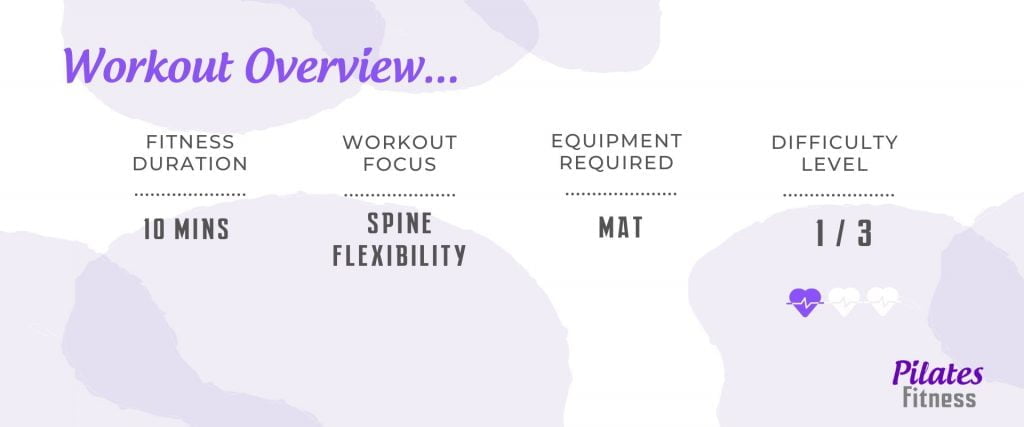
Yes, Day 1 of 14 Days Pilates Quarantine Workout - Singapore Pilates Edition is about building a strong and flexible spine. We will work on the 5 natural spinal movements to keep your vertebrae mobile and core strong. These 5 movements are spine articulation, side bends, rotation, flexion and extension.
Workout with me together in real-time, no repeated exercises and no equipment required. This real-time workout allows me to cue corrections and modifications as we go along to ensure you are always engaging the right muscles for an effective workout.
❥Day 1 - Full Body Stretch
❥Day 2 - Shoulder Stretches
❥Day 3 - No Back Pain
❥Day 4 - Loosen Those Hips
❥Day 5 - Lean Legs
❥Day 6 - Tight Abs
❥Day 7 - Standing Core
❥Day 8 - Strong Back
❥Day 9 - Even Out Scoliosis
❥Day 10 - Cardio Pilates
❥Day 11 - Coordination
❥Day 12 - Strong Arms
❥Day 13 - Butt Lift & Tone
❥Day 14 - Balance & Core
Everyone can benefit from burning more body fat from each Pilates class. We are living in a world where all of us have too little time and too much to do; getting the max out of your Pilates class is greatly appreciated by all clients. We are looking at efficiency and effectiveness. How do you spend the same amount of time and get the greatest result? Getting out of the fitness plateau may also be the motivation you need to keep at your fitness regime.
At Pilates Fitness, all our classes utilize Pilates props such as tonning balls which act as hand weights, Pilates Ring (or the Circle of Death), foam roller and more. Unless you are still nursing from injuries, try to step up on the weight of the props you use. The green tonning balls and the purple rings are heavier as compared to the rest. Same movement, heavier weights equals more fat burn. Try it the next time you come to class and observe the difference it makes to your regular Pilates class.
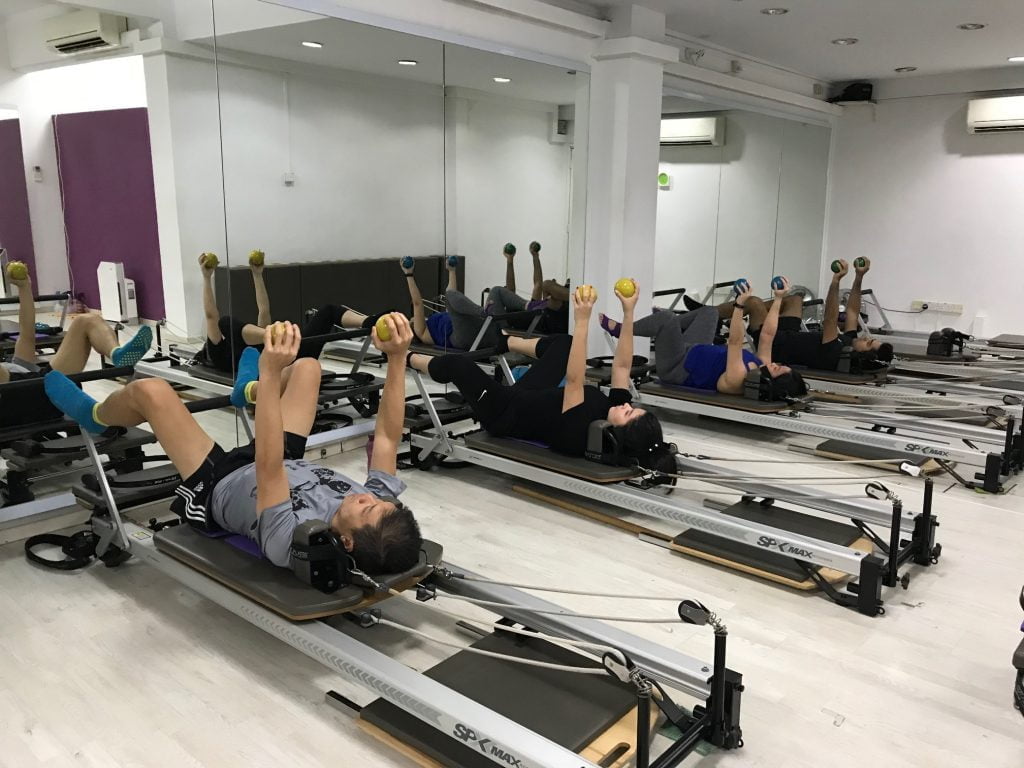
If you are extending your arms or legs, fully extend, hold for 3 seconds then return to starting position with control. Many times, I observe clients either using momentum or move too fast. In fact, when you are extending your limbs or hips, it’s the last 0.5mm of the final extension that truly tone your muscle and strengthen your core. Note that on the reformer, we are working against resistance, only when we are fully extended do we experience maximum resistance given our body proportion. We will burn more body fat when we stay for a few seconds holding maximum resistance.
Each movement should be performed with this sequence – out and hold (for at least 3 seconds), back and hold (when the carriage stop moving for at least 3 seconds). It is important to let the carriage return fully and let the muscles rest for a second or two before you go for your next repetition. This ensure each repetition is done with correct engagement of the intended muscles rather than just powering through the movement. Performing a Pilates exercise correctly burns a lot more body fat and calories as compared to seemingly doing a Pilates exercise without engaging all the right muscles throughout the journey of the movement.
The other way to maximize fat burn is to use as much core muscles as you can to ensure stability as you perform your movement. Ensuring the spine stays stabilized when you lift your arms up against resistance not only work your arms but also the muscles supporting your spine.
Visualize how a plank works. You are not moving when performing planks but you are working really hard just to maintain your form. In fitness, we call it isometric exercise. If you can maintain your form by activating other muscles while doing the Pilates exercise, you are working doubly hard. You are working hard to perform the movement and you are working hard to ensure other body parts are not moving.
This is also feedback I often get from Pilates newbies. They will comment that they feel nothing at the end of the class and question me if they should be perspiring at the end of a Pilates class. My standard reply is – look around you. The person who is perspiring or panting is probably the most experienced participant we have from this class. The reason why newbies are not “perspiring” is because they are simply doing the movement without maintaining the right form and without using the right muscles. So, next time, burn more body fat by focusing on stability before mobility.
The trick to burn more body fat for any type of exercise is to focus on lower body work – legs and glutes. This is also why squats and jumps are the most commonly suggested exercises in HIIT and bootcamps classes. The reason to focus on legs and glutes is because they are our biggest muscle groups in our body. Look into the mirror, look at the size of your right arm versus your right leg. If you spend next 30 minutes training your right leg, you will be burning more body fat as opposed to working only your right arm since there is less to burn from your right arm anyway.
Glutes is one of the biggest muscle groups and generally ignored. Clients who want to work their bums are clients who wanted a perky nice, toned bum. Clients who want to lose weight will not think about working their bums. This is incorrect. Think about efficiencies, you will burn body fat if you focus on legs and glutes workout.
So next time when you are doing your Pilates footwork exercises, put your all into those few sets. No cheating. Take no breaks. Ensure Tip 2 and Tip 3 are followed. If you want to intensify the body fat burning, grab heavier tonning balls as you perform your footwork.
Lastly, tip 5 is something that I’ve been nagging for a while. Change is the only constant. Do not accustomed to any class type or instructor.
Start with an easy class and build to an intermediate class by Wednesday. Tune down with an easy class and build up again. It’s like running outdoors on a terrain is much more effective than running uphill all the time or running on flat ground all the time. Always let your body warm up and then challenge it before letting it wind down again.
Best is if you could attend different instructor class and use different reformer at every class. Do not let your memory to set in during the 1 hour of Pilates class so that you are 100% focused and engaged.

Reformer Introduction is a FREE 30 minutes Pilates Reformer Introduction Class before your first Pilates Reformer Group Class to prepare you for your Reformer workout. As such, your first class at Pilates Fitness will be 30 minutes Reformer Introduction and 55 minutes basic class type, a total of 85 minutes.
The Reformer Introduction is compulsory for your first group class at Pilates Fitness regardless of your past Pilates Reformer experience. As the terms used in different Pilates studios may be different, the Reformer Introduction helps to ensure that the group class is conducted safely for everyone. You do not need to attend Reformer Introduction for your subsequent classes. If you choose a class slot that has Reformer Introduction, you can simply come at the class start time and skip the Reformer Introduction.
The Reformer Introduction class is specially designed for newcomers at Pilates Fitness to get the maximum out of every Reformer class. The Reformer Introduction class will:
Do note that Reformer Introduction is not required for prenatal and private classes.
Our spine or vertebral column is made of twenty-four vertebrae. When we are standing, the entire weight of our body, head and arms is transferred through these vertebrae. Spinal intervertebral discs that are between each vertebrae cushioned this shock when we move. The discs are composed of a tough outer layer, the annulus fibrosus and a liquid centre called the nucleus pulposus. When weight is placed on a disc, the annulus fibrosus supports the nucleus pulposus in compressing and distributing the pressure.
A slipped disc or herniated disc happens when the nucleus pulposus bulges out through a weakness in the outer part of the disc. It may be pressing on nearby nerves and cause severe pain or inflammation. One tends to develop a slipped disc between 30 and 50 years old; and twice as many men as women are affected. There are no permanent treatments to treat slipped disc and hence it is very important to ensure we cultivate good habits to prevent slipped disc from happening. Doing Pilates exercises is one of the easiest ways to restore the natural curves of the spine while strengthening your muscles at the same time.
H2:Pilates Exercises Promote Good Posture
How you sit, stand and move have a big impact on your spine. Incorporating good postural habits are crucial in maintaining a healthy spine. Our spine has a natural “S” shape and this “S” shape has to be maintained in every movement to ensure proper posture. Pilates exercises focus a lot on neutral position or “S” shaped-spine in every movement, hence retuning our body to get used to the neutral position that is good for our body.
Standing – Stand upright with head balanced on top of shoulders. Both legs should be straight with even weight on both feet. When doing standing Pilates exercises, we learn to notice details as such your rib cage should be balanced on top of your hip bones when standing to prevent over-arching of your lumbar spine.
Sitting – Your pelvis should be vertical and support in the small of your back to promote the natural lumbar curve. Head forward posture should be avoided to prevent over extension of neck. Your knees and hips should be level and your feet should be flat on the floor (use a footstool if necessary).
Lifting & Moving - Avoid making sudden aggressive movements or over-twisting your body in unnatural positions. Pilates exercises that promote rotation of rib cage, articulation of spine and lateral flexion will help to promote flexibility and strength. Distribute your weight evenly on both sides of the body especially on both feet.
Pilates Exercises
Exercising regularly can slow down the deterioration of your interverteral discs. It can also keep your supporting back muscles and postural muscles strong. Integrating high-impact activities, weight lifting exercises with core strengthening exercises such as Pilates exercises is useful in preventing over-straining your spine. However, it is important that you carry out Pilates exercises under guidance of qualified instructor.
Pilates Exercises such as Hip Rolls are useful in promoting articulation of your spine, strengthening abdominals to support spine especially lumbar spine, glutes and hamstrings.
STARTING POSITION
Lying on back, pelvis and spine neutral. Knees bent, feet hip-distance apart on mat. Arms by sides, palms down. Inhale to prepare.
Step 1: Exhale
Initiate from tailbone and slowly peel spine off mat until hips are lifted and weight is resting between shoulder blades, not neck. Do not arch lower back by maintaining good abdominals connection with rib cage.
Step 2: Inhale
Keep abs engaged and expand back of rib cage, keeping head and shoulders relaxed. Press evenly into both feet to engage glutes & hamstrings. Relax shoulders.
Step 3: Exhale
Soften chest, ribs, middle back and lower back as you return spine to starting position vertebrate by vertebrate.
Repeat 3 - 5 times.
Cultivating good posture and incorporating core strengthening exercises such as Pilates exercises will help you to prevent slipped disc and other back pains.
So here’s the truth: Everyone bloats. It’s not normal for someone to have rock hard abs all throughout the day (unless you don’t eat or drink). Food and liquids take up space inside your stomach and intestines, which causes your tummy to expand. Eating certain foods may also cause more gas to be produced in the stomach than others, which increases the bloat. The good news is that while we can’t fully avoid bloating, there are 3 simple ways to reduce it (hooray!).
There’s a common misconception that drinking more water increases bloating, but on the contrary, increasing your water intake actually helps to reduce the bloat! Your body retains water when you don’t drink enough; in a bloating situation, you should be drinking more fluids instead of restricting them. At the same time, avoid high-sodium foods such as processed and packaged foods as this triggers water retention.
A handy tip to keep track of your water intake is to refill a 1 litre water bottle at least 3 times a day! Another way to fight the bloat effectively is to add a slice of lemon to warm water. Consuming warm lemon water reduces water retention as lemons are a natural diuretic.
Try swapping high-sugar carbonated drinks for healthier options. If you enjoy more flavour in your water while beating the bloat, try this delicious recipe: Watermelon Celery Cucumber Juice. However, juices have frutose and frustose is a type of sugar, so don't go too crazy over the juices!
Carbohydrates are stored in the muscles as glycogen, which is a form of backup energy source. However, a high glycogen storage is unnecessary unless you have a vigorous exercise routine in place. Every gram of glycogen is stored with approximately 3 grams of water. By decreasing your carbohydrates intake, your body can then burn off the stored fuel while draining off excess fluids.
Compared to carbohydrates or protein, fatty foods take a longer time to pass through the digestive tract, and are the last thing to leave the stomach. If you want to avoid bloating, you might want to think twice before eating that basket of truffle fries (Candice: did you hear that?!) or that mouth-watering korean deep fried chicken.
Of course, I’m not saying that you have to ban yourself from fast food forever. You can have 1-2 cheat days, but the bulk of your diet should be healthy and nutritional. Remember, balance is key!

A 2008 German study published in the Journal of Gastrointestinal and Liver Diseases examined the effects of walking at a leisurely pace on a treadmill after eating a large meal. Results showed that walking helped move food through the stomach more quickly. When the stomach empties faster, gas is able to move more quickly into your small intestine, reducing the amount of bloat.
Strengthening your abdominal muscles with routines such as Pilates also helps in moving gas through the intestines. You will not only achieve a toned appearance that results in a less bloated-looking belly, but also improve your core strength which is essential in supporting efficient bodily movements and reduces the risk of injuries.
Bloating is a common issue that can be easily reversed with the right diet choices and regular exercise. Let us know if these tips worked for you! Fight the bloat and book your next Pilates class here. See you in class soon! 🙂

