Rotation of the body is used often in our daily lives, e.g. turning towards your bedside to shut your phone alarm in the morning, turning to talk to someone behind you, or even turning to get the toilet paper in the loo. Since we rotate the spine frequently and unconsciously every day, why is it important to strengthen our obliques in rotation?
To answer this question, let's first take a deeper look at the muscles involved in a spinal rotation:
Transverse abdominis are the abdominal muscles closest to our spine and organs, often referred affectionately by Pilates Instructors as TA. TA is THE MUSCLE that Pilates instructors are cueing you to engage in all Pilates movements. This is the most important CORE MUSCLE in your body. When you activate the transverse abdominis during movements, your tummy becomes flatter in engagement as the transverse abdominis tightens and press downwards towards your spine, thereby stabilising your spine and providing support.
Rectus abdominis or the six-pack are the abdominal muscles furthest from your spine and closest to your skin. Hence when it is toned, the definition is very obvious. Rectus abdominis is the muscle that we are discouraging you to activate during Pilates movements. When you engage the rectus, your tummy bulges up in a small hill and your transverse abdominis will be relaxed.
In the article, we will be focusing on External Obliques and Internal Obliques.
Contracting the external obliques rotates the trunk toward the opposite side, as seen in the Bicycle Crunch below:
On the other hand, the internal obliques flexes and rotates the trunk towards the same side, like in a side plank:
Doing these 2 exercises daily (with a combination of the right diet and cardio exercise) will definitely strengthen your core and tone up your obliques. If you're not sure how toned obliques look like, it's the 2 lines at the side of the 8 pecs that this hunky man is pointing to:
Having firm obliques not only looks good, but also supports the back and overall posture. This helps prevent injuries and pain especially associated with the lower back and shoulders.
When we twist our torso, the muscles in our core, shoulders and back simultaneously contracts and lengthens on each side. However, it's common to lead a rotation from the shoulders rather than further down the spine, especially for desk-bound workers who have a lot of tightness in their neck and shoulders due to prolonged sitting in front of the computer.
Here's the correct way to twist the spine while seated upright:
First, ground the hips evenly on both sides. Lengthen your back from the bottom of the spine all the way up to the top of the head. (Picture A)
Then, reach the opposite ribcage forwards as you begin to rotate the other ribcage back, growing taller as you twist. Your pelvis will be stationary and facing square forward. Rotation comes from ribcage movement and not shoulder or pelvis movement. (Picture B)
Tip: Allow the shoulders to follow spinal rotation rather than to lead spinal rotation.
Repeatedly rotating the spine the wrong way might result in weak and unresponsive obliques. The back muscles start to compensate for the lack of abdominal work, causing a lack of support on the spine (bad posture). In the long run, you might start to feel tightness and compression on the lower back area due to an excessive anterior pelvic tilt.
If this posture is not corrected, the degeneration of the spinal discs may occur, resulting in chronic pain. You can read more about the dangers of having an excessive anterior pelvic tilt here.
Having correct spinal rotation patterns also increases flexibility in the thoracic spine (upper and mid back), which helps to release nagging aches and pains in the shoulders and neck.
Now that you know the benefits of improving the way you rotate your body, here are some tips to perform this month's rotational flow better:
Do each of the exercises 8 - 10 times for each side. It will take you 5 - 8 minutes. You should do it on the floor with the support of a Yoga/Pilates mat or a soft towel on a carpeted floor. These exercises should not be performed on the bed! You can do these exercises first thing in the morning to increase flexibility of your spine or at the end of the day to stretch out those tired muscles.
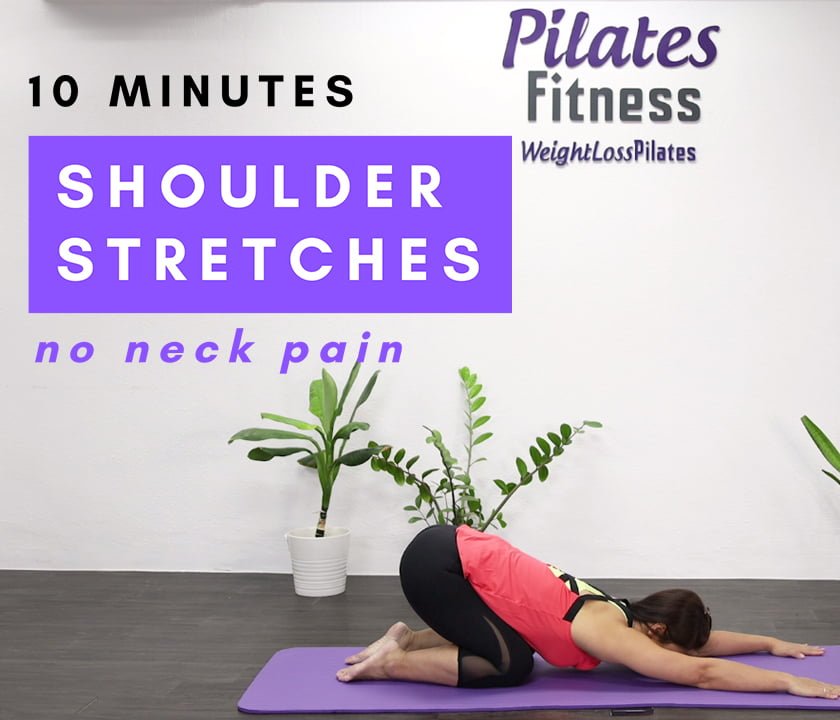
The easiest way to reduce shoulder tension is to learn to relax those upper trapezius muscles. Also, we have to strengthen our latissimus dorsi and lower-mid upper trapezius. The 10 minutes online Pilates class will stretch your pectorals (chest muscles) and increase your shoulder mobility to reduce neck tension, shoulder pain and shoulder stiffness.
All workouts in the 10 Minutes to Your Best Body Workout - 14 Day Quarantine Workout – Singapore Pilates Edition are suitable for all genders, young, seniors, and even those going through rehabilitation for frozen shoulders. I've created these 10 minutes classes - Singapore Pilates Edition to cater to the local population. I will work out with you in real-time, 1 minute per exercise, no repeated exercises and no equipment required.
This 10 minutes Pilates class is real-time so it feels like you are in a Singapore Pilates class with me cueing corrections and modifications as we go along to ensure you are always engaging the right muscles for an effective workout.
Repeat the Shoulder Stretches video at least twice a day – ideally once at the start of the day and another round before dinner. This is a self-regulated Pilates class – meaning you can do faster or slower than me but try to keep to sustain the 1 minute per Pilates exercise. I would also recommend you to start with Day 1 to Day 6 into your daily routine to keep you moving throughout the day. If you are doing from Day 1, you can focus on just one round for each day.
Workout with me together in real-time, no repeated exercises and no equipment required. This real-time workout allows me to cue corrections and modifications as we go along to ensure you are always engaging the right muscles for an effective workout.
❥Day 1 - Full Body Stretch
❥Day 2 - Shoulder Stretches
❥Day 3 - No Back Pain
❥Day 4 - Loosen Those Hips
❥Day 5 - Lean Legs
❥Day 6 - Tight Abs
❥Day 7 - Standing Core
❥Day 8 - Strong Back
❥Day 9 - Even Out Scoliosis
❥Day 10 - Cardio Pilates
❥Day 11 - Coordination
❥Day 12 - Strong Arms
❥Day 13 - Butt Lift & Tone
❥Day 14 - Balance & Core